
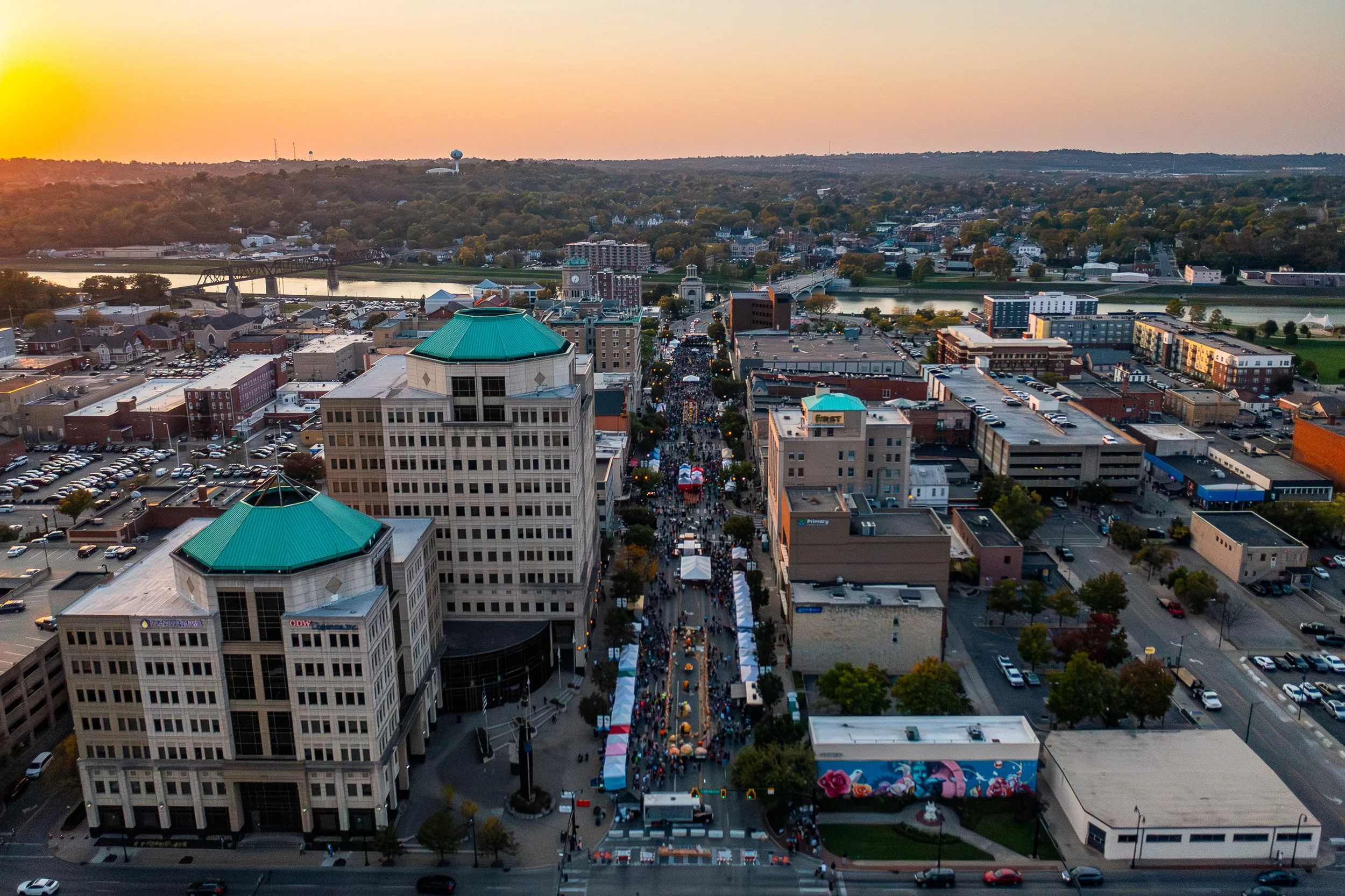
Hamilton matters because the Cincinnati market does not behave like one flat downtown radius. Buyers move between the convention district, the Sharonville expo belt, Butler County hotel inventory, Northern Kentucky riverfront venues, and the airport corridor depending on the show, the audience, and the room block. Hamilton sits inside the Cincinnati market as a working submarket with its own routing, venue mix, hotel pattern, and planning pressure.
Strong planning in Hamilton starts with routing, venue fit, hotel behavior, staffing logic, and the travel path the crew will actually feel once the schedule gets tight. Those details change how install pacing, live support, and strike should be scoped even when the brand objective stays the same.
Hamilton gets harder to plan when people talk about the market in broad metro terms and ignore how downtown, the north corridor, Butler County, and Northern Kentucky actually behave. Buyers working in Hamilton usually also need to weigh nearby venues such as Cincinnati Music Hall, adjacent submarkets such as Hamilton, and service layers such as Expo Logistics and Shipping so the plan stays practical from the start.
The useful outcome is not another general market summary. The useful outcome is a clearer sense of how this part of Cincinnati behaves once freight, labor, room transitions, and guest movement are treated as real event conditions instead of background details.
- Treat Hamilton as a real submarket inside the Cincinnati event system, not as a duplicate of the next neighborhood over.
- Use Cincinnati Music Hall and nearby hotel or event inventory to define staffing, freight, parking, and arrival assumptions.
- Account for how Hamilton connects back to Downtown Cincinnati, Sharonville, Northern Kentucky, or the Airport Corridor once crews and attendees start moving.
- Confirm access windows, order deadlines, power, internet, and room constraints early enough to change design and procurement decisions.
- Assign show-site leadership before move-in so venue questions and punch-list items do not bounce between vendors.
- Treat strike, returns, storage, and the next stop as part of the first planning pass.
How Hamilton fits the Cincinnati market
Hamilton belongs inside the full Cincinnati tri-state event map, not as a disconnected tactic. Treat Cincinnati as a tri-state event market. Anchor the downtown convention district first, then cover Sharonville and the north I-75 corridor, Butler County growth markets, the east-side business corridor, Northern Kentucky riverfront venues, and the CVG airport corridor that feeds exhibitor, staff, and attendee movement. That regional shape matters because downtown convention work, the Sharonville expo corridor, Northern Kentucky convention and hospitality inventory, and the CVG-facing hotel belt do not all create the same operational pressure.
Consumer Home, Garden, and Lifestyle Expos is one of the clearest active demand drivers in this market. Consumer shows still create reliable downtown traffic for exhibitors that need product displays, demos, and selling space to work under sustained floor traffic. That makes Hamilton a real planning question for buyers because timing, venue fit, attendee behavior, sponsor pressure, and service coordination all change with the brief.
A useful Hamilton plan helps teams understand who the submarket serves, what nearby venues matter, and how routing and staffing should change. The useful outcome is a clearer sense of how Hamilton connects to venue choice, delivery sequencing, and the surrounding Cincinnati venue clusters across Downtown Cincinnati Convention District, Sharonville and Cincinnati North Corridor, Butler County Growth Corridor.
The point is to make the decision practical. Buyers should come away with a better sense of what needs to be decided first, what room conditions matter most, and how the next production decision changes once the market context is real.
- Connected to Cincinnati Music Hall
- Written for Hamilton and the wider Butler County
- Scoped for real room conditions and show-week execution
- Structured to help buyers compare fit, timing, and ownership
Venue rules, labor posture, and routing realities
Cincinnati should be treated as a mixed, venue-directed labor market. Downtown convention work, suburban expo facilities, NKY convention inventory, stadiums, and hotel venues each publish different ordering, AV, catering, and exhibitor-service paths. Final labor expectations should always be confirmed in the current exhibitor kit, service order form, private-event agreement, and organizer manual. That public positioning matters because the Cincinnati market is mixed and venue-directed. Cincinnati event work usually gets cleaner when room access, utilities, AV, labor timing, and install sequencing are settled before the calendar starts forcing rushed choices. Labor, utilities, IT, rigging, AV, and decorator flow all need to stay grounded in the actual room and event workflow instead of broad assumptions carried over from another show.
Cincinnati Music Hall is especially relevant here because it is tied to keynote nights, cultural offsites, gala programs, and high-character corporate events near the convention core, with Best used as a signature hospitality or presentation venue rather than a trade-show-floor anchor. Cincinnati Music Hall is a fit for Useful for keynote nights, cultural offsites, gala programs, and high character corporate events near the convention core., Best used as a signature hospitality or presentation venue rather than a trade show floor anchor.. Details like that change how teams schedule advance work, decide on pre-build versus on-site assembly, choose the right freight path, and protect enough time for final checks before the event opens.
Hamilton matters for routing as well. Secondary Butler County market that expands north-corridor presence beyond West Chester and Mason. That location logic affects staff movement, hotel blocks, truck access, rehearsal schedules, and the buffer needed between meeting rooms, exhibit floors, hospitality programs, and strike. Any workable plan for Hamilton has to acknowledge those local realities.
When buyers miss those realities, the problems show up fast: compressed install windows, wrong staffing assumptions, late utility changes, and a project plan that feels much more expensive than it looked on the first call.
How the scope is structured before move-in
The cleanest path is to translate Hamilton into a schedule early. That means confirming the brief, mapping graphics and fabrication milestones, ordering show services, lining up labor and technical needs, and deciding who owns field leadership once the room starts changing. Expo Logistics and Shipping often becomes the connective layer because it forces those decisions into one shared show plan instead of leaving them across multiple inboxes.
That sequencing matters especially when the project connects to Consumer Home, Garden, and Lifestyle Expos or other buyer groups that expect strong brand control and predictable execution. Buyers do not experience the project as separate departments. They experience one booth, one registration environment, one event floor, or one sponsor activation. The plan behind the scenes should feel just as coordinated as the environment they see live.
Cincinnati event work usually gets cleaner when room access, utilities, AV, labor timing, and install sequencing are settled before the calendar starts forcing rushed choices. When those conditions are acknowledged before move-in, the team can make better decisions about booth format, staffing level, furniture, utilities, staging, rehearsals, loading windows, and the sequence for install and dismantle.
That is what keeps the brief from turning reactive. A stronger sequence reduces rework, keeps design and operations pointed at the same objective, and gives the field team a clearer job once they are in the room.
Show-week control and field leadership
No matter how strong the pre-show brief is, Hamilton still needs a clean decision path once the team is onsite. That means naming who answers venue questions, who owns the production calendar, who manages labor and AV handoffs, and who closes punch-list items without letting them bounce across vendors. Field leadership is what keeps a straightforward build from becoming reactive once the dock opens or the ballroom flips.
In Cincinnati, that show-week control also has to account for how venues are distributed across the market. A downtown convention-center project can overlap with sponsor events on the riverfront, hotel functions in Covington, or hotel-rooming pressure in Sharonville. Those overlaps are why location, venue, and service decisions have to stay coordinated from the start.
The output should feel calmer, not louder. Strong field control is not about making a bigger promise. It is about reducing confusion, protecting timing, and making sure that every last-minute choice still respects the room conditions, the labor posture, and the broader project path established before move-in.
That calm matters because buyers feel it immediately. The event looks more intentional, the crew has fewer avoidable collisions, and the room is able to support the commercial objective instead of constantly demanding emergency fixes.
Budget, logistics, and repeatability
Hamilton is also a budget and repeatability question. Buyers usually want to know whether the plan is helping them control cost, shorten lead time, improve reuse, protect visual quality, or make the next show easier to absorb. Those are valid questions, and they need to be answered in a way that still respects venue behavior and the actual handoff between fabrication, storage, freight, install, live days, and returns.
That is where Cincinnati's market shape matters again. Downtown programs, Sharonville expo work, Butler County meetings, and Northern Kentucky hospitality events create different financial pressures even when the brand objective sounds similar. Freight windows, labor posture, hotel density, and venue-managed services all change the path. Strong plans have to answer to those site-specific conditions instead of pretending one market pattern solves every brief.
Repeatability matters because a strong project often starts with one show and expands into multiple cities, repeat annual events, or a broader regional program. When Hamilton is planned correctly the first time, it becomes easier to scale, easier to brief internally, and easier to adapt when the venue, footprint, or supporting services change.
That does not mean every choice has to be conservative. It means the plan should understand which decisions deserve investment now and which ones should stay flexible so the next stop is easier instead of harder.
What stronger planning looks like in practice
Stronger planning is specific without sounding narrow. It speaks directly about room behavior, setup pace, staffing logic, show-week control, and the business outcome the event has to support. It does not hide behind abstract positioning or pretend every venue and format creates the same event problem.
That specificity helps buyers trust the path because they can see how the work will behave once people, product, utilities, freight, labor, and deadlines are all moving at once. The goal is to sound like a team that has already thought through the room, not like a generic description of trade shows in the abstract.
When that clarity is present, the next conversations get faster. Buyers can choose the right venue, the right support stack, and the right production order with fewer detours because the implications of the decision are already visible.
What buyers usually sort out next
A buyer rarely stops at Hamilton alone. The next decision is usually whether the work belongs in Cincinnati Music Hall, whether the plan should be anchored around Hamilton, or whether Expo Logistics and Shipping needs to be scoped at the same time so labor, freight, graphics, and onsite leadership stay inside one shared plan.
That is where the surrounding Cincinnati topics become useful. Venue planning clarifies building pressure and service-order realities. Location planning helps frame routing, hotel behavior, and how the project sits inside the wider Butler County region. Service planning makes it easier to define who owns the live execution once the brief moves from strategy into production.
The practical goal is simple: help the buyer move from a broad interest in Hamilton to a tighter plan with the right venue, the right support stack, and the right next conversation before deadlines start collapsing the schedule.
Trade show work in Hamilton
Hamilton is part of the Cincinnati event market. Shows and meetings book here alongside the larger Cincinnati calendar.
Hamilton sits in the Butler County area.
Production for Hamilton shows starts with the same brief we run for the rest of Cincinnati: venue specifics, show dates, footprint, outcome. Freight paths and local vendor availability are the variables that shift from the city core.
The Cincinnati event landscape
Cincinnati runs one of the busiest trade show calendars in the region. Convention weeks stack close together, hotel blocks compete for the same nights, and the venues themselves shape what is possible on the floor.
The attendees vary by show — some weeks draw regional operators, others pull international buyers in for a single conference — but the floor mechanics stay consistent. Every booth needs graphics production, show services, labor calls, and a plan for the specific building it's landing in.
it offers 55+ nonstop destinations and that nearly 70% of passengers departing CVG reach their destination nonstop, based on service provided through February 2026 — a useful reference point when sizing a project.
it has more than 10 private event spaces, Hard Rock says it has more than 50,000 square feet of flexible event space, and the Reds market dedicated special-event spaces inside Great American Ball Park, which sets the practical ceiling for a booth program working the market.
Association Conferences and Citywide Meetings is one of the sectors that shapes the Cincinnati calendar. The reopened downtown convention center and adjacent district infrastructure strengthen Cincinnati's citywide convention story.
How we're built to run your project
Trade Show Services of Cincinnati operates out of Cincinnati with a full in-house production shop. Custom fabrication, rental inventory, graphics production, and show-site labor live under one roof.
The difference from a national vendor shows up at the dock. A local team with an in-house shop can solve most install-day problems in the time it takes to drive back to the building with the right part.
Over a multi-show calendar, the compound value of a single team shows up in fewer surprises. The second install is faster than the first, the third is faster than the second, and by the fourth the project runs on memory and documentation rather than first-principles planning.
The buildings that host Cincinnati events
Different Cincinnati venues mean different floor plans, different labor rules, and different freight realities.
The right building depends on the show: a consumer expo wants open aisles and broad traffic flow; a corporate conference wants controlled breakout space; a brand activation wants a venue that can carry scenic and production without fighting the architecture.
Great American Ball Park. The newly renovated space spans 45,000 square feet and can accommodate cocktail receptions up to 6,000 guests or rounds up to 750 guests.
The Reds also market the Champions Club as the ballpark's largest climate-controlled premium space.
Drees Pavilion: the venue is a 10,000-square-foot pavilion located minutes from downtown Cincinnati.
How Cincinnati floor operations work
Labor in Cincinnati runs venue-by-venue, not citywide. Each building publishes its own rules for who handles what on the floor.
The workable version of Cincinnati labor planning is boring on purpose: read the manual, match the scope to its categories, order what the venue sells directly, and schedule everything else around its posted windows. Surprises almost always trace back to a step someone skipped.
Northern Kentucky Convention Center — NKYCC's official IT and price-list materials show exclusive in-house voice / data services, client labor pricing for cable patch work, and floor / standard / discount order timing through the center's services team.
Practical planning rules for Hamilton in Cincinnati: Use language such as 'venue-directed services', 'service order form', 'exhibitor kit review', 'event-planning guide', and 'show-site coordination aligned with the venue rules'. Treat Cincinnati as tri-state and mixed: downtown convention work, Sharonville expo work, NKY riverfront events, and stadium / university venues all behave differently.
What's included in the project scope
Projects in Hamilton typically include design work, fabrication or rental sourcing, graphics production, show-service paperwork, freight, install, show-hours coverage, and strike.
Typical line items include booth structure (custom or rental), graphics and print, AV and lighting, show-service orders (power, internet, rigging), labor calls against the venue's rules, freight both ways, on-site supervision, and post-show closeout documentation.
A well-run project has few surprises on install day because the handoffs upstream were tight. A bad one has many, because they weren't.
For programs that repeat, asset management becomes part of the engagement — storage, graphic rotation, refurbishment, and re-crating are planned rather than one-off.
A clean scope definition also calls out what isn't included: show organizer fees, client staff travel, and anything the client already has under contract (lead capture platforms, CRM integrations, promotional giveaways). Those run alongside the engagement rather than inside it.
How a project runs
First step on any project is pinning down the show, the floor plan, the deadlines, and what success actually looks like. Everything downstream hinges on those answers.
Venue coordination comes next. That means pulling the current exhibitor manual, confirming dock and freight windows, submitting rigging approvals where needed, and placing utility orders against the building's published specs.
With venue details locked, production runs. Build, print, AV integration, rentals, and the show floor lead's playbook all come together in this phase.
The install phase has one owner on the floor. That person handles the labor calls, the graphics questions, the sequence adjustments, and the daily update.
During show hours, the booth functions as a live operating space. A booth supervisor manages repairs, sponsor requests, lead-capture issues, and any venue questions so client staff can focus on conversations.
After the show, strike runs against the venue's posted window, and a same-day debrief captures what held and what needs to change before the next date.
What it costs and how fast it moves
Pricing is driven by real line items: fabrication or rental, graphics, show services, labor, freight, and travel where it applies. Round numbers without that breakdown usually hide something.
The levers that matter: build path (custom, rental, or hybrid), footprint, venue service fees, graphics, freight, and supervision days. A 10x10 turnkey rental and a 30x50 custom island with a double deck are entirely different projects.
A clean schedule starts 4 to 5 months out for custom work and 2 to 3 months for rentals. Shorter lead times are workable but push rush premiums and limit material choices.
Outcomes we optimize for
A successful project in Cincinnati looks like a booth that lands on time, passes venue inspection on the first walk, runs without incident through show hours, and ships out the same day it strikes.
Exhibitors who measure programs seriously track leads, floor-booked meetings, and post-show pipeline. The build and the install are upstream inputs to those KPIs.
Client teams sometimes want the booth to carry the pipeline on its own, but the best-performing programs treat the booth as a platform and put real operators on it. On-floor conversation discipline moves the KPIs more than any scenic decision.
Frequently asked questions
Do you only work in Hamilton?
No. Trade Show Services of Cincinnati treats Hamilton as one part of a wider Cincinnati and Northern Kentucky service radius that includes the downtown convention district, Sharonville, Butler County, the riverfront, and the airport corridor. Buyers often move between those submarkets on the same project, so the planning has to account for the larger region and the different routing pressure each submarket creates once crews, freight, hotels, and live support are all in motion.
Why does Hamilton need its own planning approach?
Hamilton changes routing, nearby venue options, staffing assumptions, hotel behavior, and how buyers move between meetings, exhibit floors, and hospitality events. Strong location planning explains those differences clearly enough that a buyer can tell whether the submarket helps or hurts setup pace, guest movement, budget discipline, and the overall event plan instead of assuming every Cincinnati submarket behaves the same way.
How should labor expectations be described publicly?
Cincinnati should be treated as a mixed, venue-directed labor market. Downtown convention work, suburban expo facilities, NKY convention inventory, stadiums, and hotel venues each publish different ordering, AV, catering, and exhibitor-service paths. Final labor expectations should always be confirmed in the current exhibitor kit, service order form, private-event agreement, and organizer manual. That is the safest public posture because the Cincinnati market is mixed and venue-directed. Labor answers should stay anchored to the actual room, the event format, and the live service workflow instead of broad assumptions that may not survive contact with the real venue conditions.
Can a project start in Hamilton and extend into nearby markets?
Yes. That is common in the Cincinnati tri-state market. The important part is keeping one readable schedule for freight, venue communication, labor, AV, graphics, and dismantle so the move between Hamilton and nearby venues does not create duplicated effort or missed handoffs. When the submarket shifts, the room type, hotel behavior, parking, and crew movement can shift with it, so the event plan needs to stay coordinated instead of being rebuilt piecemeal.
What should a buyer confirm first for Hamilton?
Start with the actual venue, event date, service mix, and how the location connects back to the wider market. That will usually clarify whether the next step is a venue comparison, a service decision, a booth-format decision, or a broader routing conversation. Once those details are visible, the rest of the schedule becomes easier to organize because the team is planning against a real venue environment instead of a broad metro assumption.
Do you work at Delta Hotels Marriott Cincinnati Sharonville?
Yes. 17,405 square feet of total event space and a largest-space capacity of 1,100. Projects at that building are planned against its specific floor rules.
How does labor work in Cincinnati?
It runs venue by venue. Cintas Center: Xavier University's official events sections say Cintas Center events are supported by full-service planning, catering, and AV support. Other Cincinnati venues have their own published rules, and the plan matches the specific building.
How much lead time is ideal?
Custom builds run best with 16 to 20 weeks of lead time. Rentals take 8 to 12 weeks. Work inside 4 weeks is possible but raises costs and narrows the options.
What information kicks off a project?
The show, the venue, the booth number, the dates, and a target budget range. From those, an initial scope and a realistic cost come back within a few days.
Who runs the booth on-site?
One named show-site lead runs the install, the show hours, and the strike. That person carries the floor plan and the punch list from crates to doors and reports up once a day.
Can the booth travel to the next city on our calendar?
Yes — builds are designed for modular reuse unless single-use scenic is specifically required. Same structure, swappable graphics, standard crates. Cincinnati programs that roll to another city on the same calendar get handled end to end.
What happens if something breaks during show hours?
The show floor lead handles it. Minor repairs happen in place; anything larger gets sourced from the local fabricators or rerouted through the venue's service desk.